
When to Replace Flooring After Water Damage
Some flooring can be dried and saved. Some can't. Here's how to tell the difference.
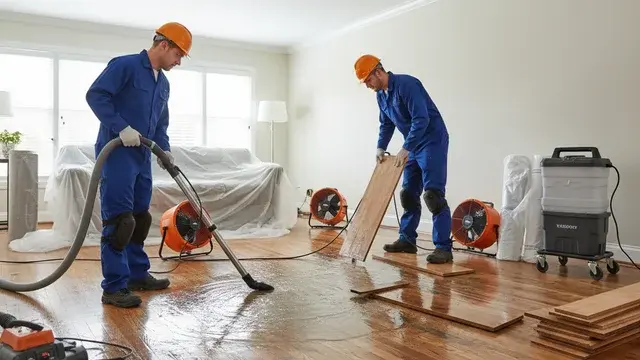
After water damage, one of the biggest decisions is whether to dry existing flooring or replace it. The answer depends on the type of flooring and how badly it was affected.
Hardwood
Solid hardwood can often be saved with specialty drying — drying mats pull moisture up through the boards. Cupped boards sometimes flatten as they dry; heavily cupped or crowned boards usually need sanding and refinishing. If boards are buckled (lifted off the subfloor), they usually have to be replaced.
Engineered Hardwood
Harder to save. The adhesive layers separate when wet and once they delaminate, there's no fixing it. Caught very early, sometimes salvageable. Usually replaced.
Laminate
Generally not salvageable after water damage. The core swells when wet and doesn't return to size. Small dry areas may be okay; wet areas should be replaced.
Luxury Vinyl Plank (LVP)
Vinyl itself is waterproof, but water gets underneath and saturates the subfloor or pad. LVP can often be lifted, the subfloor dried, and the planks reinstalled — if they haven't been glued down.
Tile
Tile is waterproof, but grout and the subfloor below aren't. If the subfloor gets wet, tiles loosen and grout fails. Drying the subfloor from below (crawl space or basement) or above (after tile removal) determines the outcome.
Carpet and Pad
Carpet is often salvageable with fast extraction, cleaning, and drying — if the water was clean (Category 1). Padding almost always has to be replaced because it holds moisture against the subfloor. Category 2 or 3 water usually means both carpet and pad are replaced.
Subfloor
Plywood and OSB subfloor can sometimes be dried and saved. If it's swelled significantly, delaminated, or been wet more than a few days, it usually needs to be cut out and replaced.
Need help with water damage in Baltimore?
Our team is open 24 hours for emergency water damage response across Baltimore, MD.